
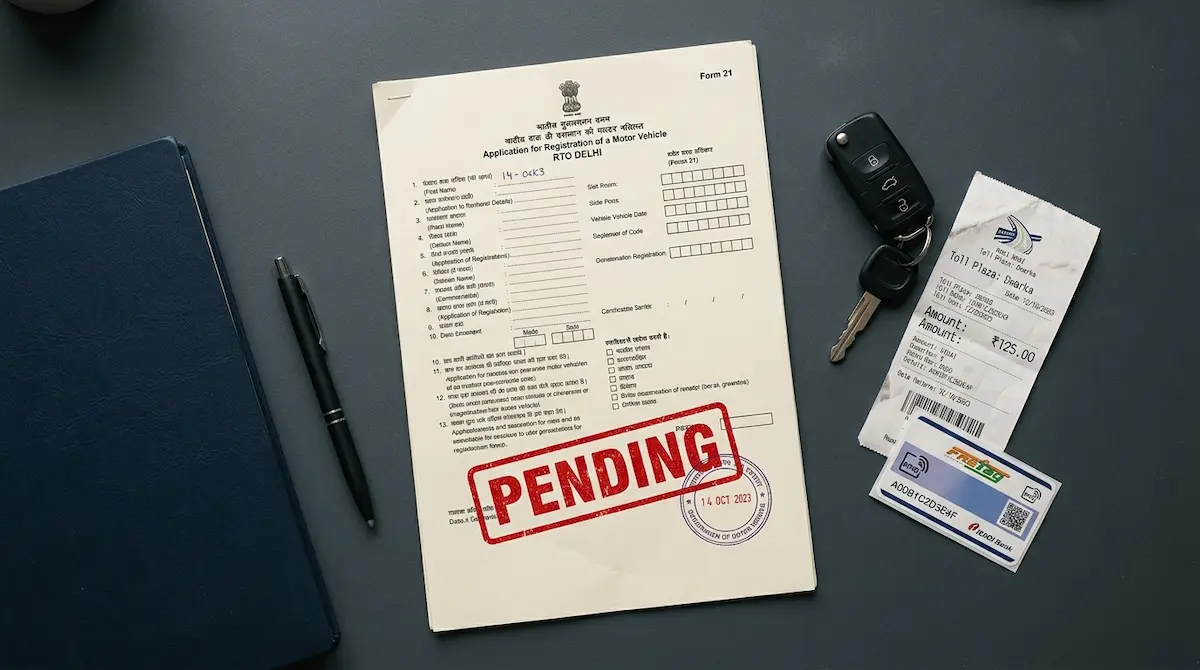
Form 28 NOC Blocked by Unpaid Toll Dues
Since January 2026, an unpaid highway toll can freeze your vehicle paperwork. Not a challan. Not road tax. A toll crossing that was recorded but never actually paid.
If your Form 28 application is stuck, or a fitness renewal was refused without explanation, check this first.
What changed
MoRTH notified the Central Motor Vehicles (Second Amendment) Rules, 2026 through G.S.R. 28(E), announced on 20 January 2026. Three services now require zero unpaid National Highway user fee:
| Service | Rule | Consequence |
|---|---|---|
| No Objection Certificate (Form 28) | Rule 55 | Not granted until dues cleared |
| Certificate of Fitness | Rule 62 | Renewal or generation refused |
| National Permit | Rule 90 | Must carry zero unpaid user fee |
Form 28 was amended too. It now carries a declaration asking whether any unpaid user fee demand is pending against the vehicle. Rule 58 allows Part-III of Form 28 to be issued electronically.
“Unpaid user fee” is not a low FASTag balance
The rules define it as fee payable for using a National Highway section where the Electronic Toll Collection system recorded your vehicle’s passage but the money was never received.
Two conditions. Passage recorded. Payment missing.
So you can have a fully recharged, active tag today and still carry an unpaid user fee from a crossing months ago — from a short balance at that moment, a failed bank-side transaction, a blacklisted or unread tag, or a tag still mapped to the previous owner’s account.
The clock that puts the block into VAHAN
The January amendment says the service is refused. A second set of rules explains how the RTO finds out.
The National Highways Fee (Second Amendment) Rules, 2026 took effect 17 March 2026. Rule 14 runs on fixed timelines:
- Day 0 — an e-notice is sent by SMS, email or app, listing vehicle details, date and location of passage, and amount payable.
- Within 72 hours — the amount payable is twice the toll, but paying inside 72 hours means only the original toll applies.
- Within 72 hours — you may instead file a representation on the designated portal. It must be disposed of within five days, failing which the claim lapses.
- After 15 days — if unpaid with no representation pending, the amount is recorded in VAHAN and restrictions apply to vehicle services.
That 15-day mark is when your Form 28 stops being routine. NETC is integrated with VAHAN, so the RTO screen reads the same record.
Clear it in this order
- Check SMS and email on the number registered against the RC, not your current one. If those details are outdated, fix them before anything else — the update process is covered on our mParivahan guide.
- Pull the FASTag statement from the issuing bank. Look for failed or reversed transactions, not just deductions.
- Pay, then wait a day or two for VAHAN to reflect the clearance.
- Answer the Form 28 declaration honestly. It is a solemn declaration under Section 48.
- File.
The Section 48 point worth knowing
Section 48(3) requires the registering authority to communicate grant or refusal in writing within thirty days, with reasons recorded. Section 48(4) says that if it neither refuses nor communicates refusal in that window, the NOC is deemed granted.
Read that carefully. Deemed grant protects you against silence, not against a reasoned refusal — and unpaid user fee recorded in VAHAN is now a lawful ground for refusal. Clear the dues first, then let the thirty-day rule work if the file goes quiet.
Buying or selling across states
The liability sits on the vehicle record, not the driver. A seller’s unpaid toll from six months ago stalls the buyer’s NOC.
Treat it as a separate check from pending challans and road tax — three different liabilities under three different laws. Ask for a current FASTag statement, and make NOC issuance a condition of final payment. The NOC is valid six months; a toll dispute can eat a third of that.
For fleets, Rule 90 is harshest: one failed transaction can hold a truck’s permit. Reconcile tag statements monthly, not at renewal.